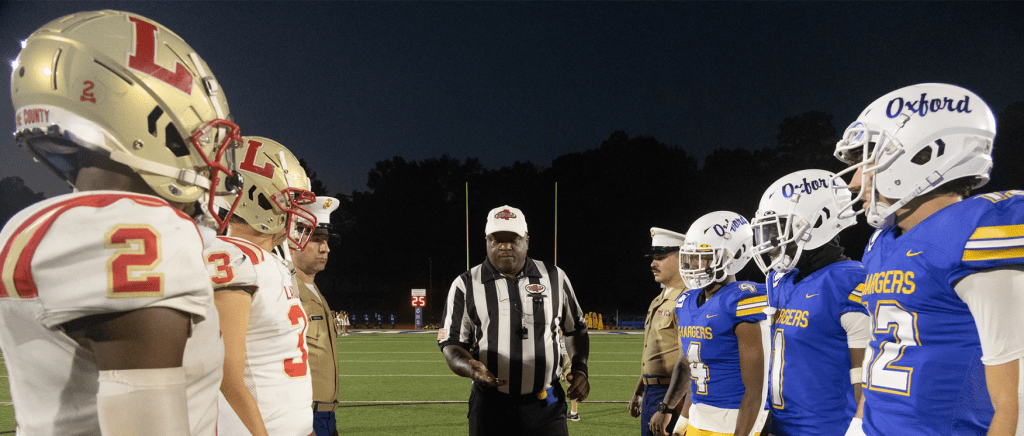
Lafayette and Oxford weren’t just rivals. They were part of each other. For half a century, the Crosstown Classic was the pulse of Lafayette County.
Now that pulse is gone.
Administrators call the decision to end it a “strategic move.” They mention classifications, enrollment gaps, and regional structures. They talk about competitive balance and scheduling flexibility.
On paper, it all sounds reasonable. In reality, it misses the point.
This game was never about numbers. It was about identity. The week of the Crosstown Classic wasn’t just another week. It was a feeling. It was the sound of bands echoing through neighborhoods and student sections showing out on Friday night.
And beyond the emotion, it was smart business.
The game drew crowds of 6,000 or more. That kind of turnout brought real financial support. The gate receipts helped the programs. The concessions funded booster clubs. The restaurants, gas stations, and small businesses around town all saw a lift that weekend.
For one night, local commerce and school spirit moved in the same direction.
You don’t get that from a replacement game against a mid-tier opponent. Rivalries like this are rare. They’re economic engines and cultural anchors. When you take one off the calendar, you don’t just lose a football game. You lose one of the few things that still unites a county like Lafayette.
When Lafayette dominated in the early 2000s, Oxford didn’t walk away. They rebuilt. When Oxford gained control of the series, Lafayette didn’t back down. That’s what a rivalry teaches. It’s not supposed to be easy. It’s supposed to make you better.
This decision might make sense from a logistics standpoint, but it fails the test of competition. It tells players that avoiding a challenge is an acceptable choice. It tells fans that convenience outweighs tradition. It takes something authentic and replaces it with something ordinary.
The Crosstown Classic also carried meaning beyond the scoreboard. It raised thousands for the United Way through its annual challenge. It gave both schools a reason to compete and collaborate at the same time.
That’s gone now too.
Administrators say the goal is to find opponents “more aligned” by classification. That might simplify scheduling. But what’s the cost of erasing 50 years of shared history? Rivalries like Lafayette–Oxford are the foundation of high school athletics. They build identity. They create lifelong memories. They give young athletes a sense of what representing their community really means.
You can’t replace that with a different date on the schedule. You can’t recreate that kind of energy or meaning.
The Crosstown Classic wasn’t outdated. It still mattered to both schools, to both fan bases, and to the local economy. Ending it doesn’t protect the programs… it weakens what makes them special.
Tradition isn’t supposed to be convenient. It’s supposed to mean something.
And this one did.
Hopefully, this is just a temporary pause in the rivalry, not the end of one of Mississippi’s great high school traditions.

 GORESPORTS.net
Leave a reply to jovialblaze1c65890bbc Cancel reply