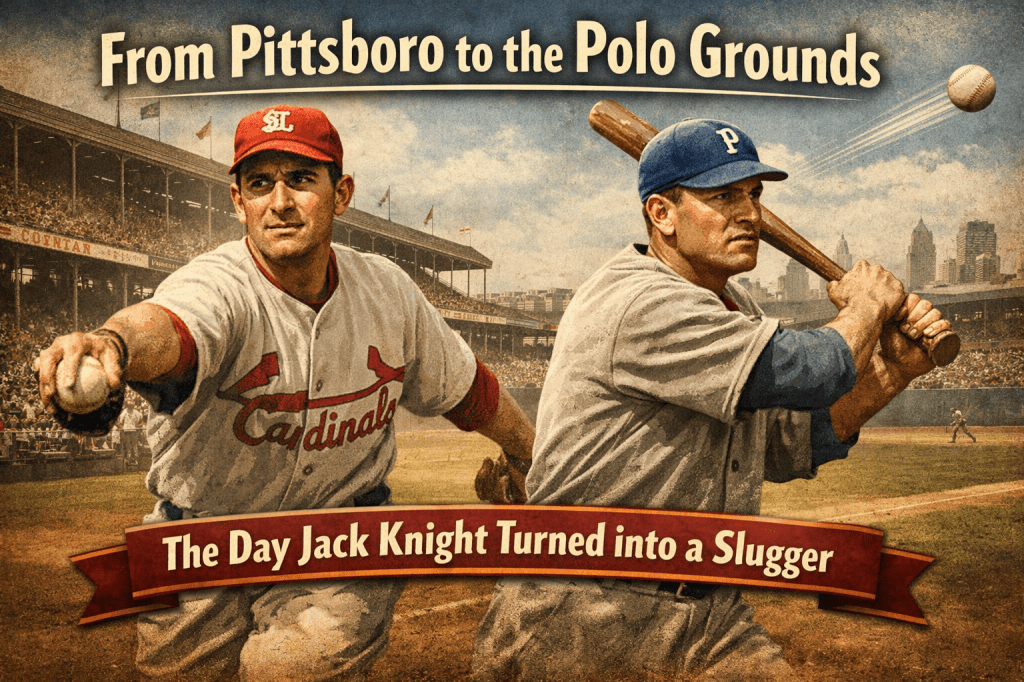
Jack Knight never got the kind of career that comes with a plaque or a documentary. He got something rarer and stranger when a pitcher stepped into the batter’s box and, for a few innings, turned a footnote into a headline.
Knight pitched in the majors from 1922 to 1927 and logged 72 games across the St. Louis Cardinals, Philadelphia Phillies, and Boston Braves. His line on the back of the card is blunt showing a record of 10–18, a 6.85 ERA, 255 innings. But that’s the thing about the 1920s National League. The numbers do not always explain the days. Sometimes the day explains the numbers.
Knight was born January 12, 1895, in Pittsboro, Mississippi, and attended Millsaps College. He threw right-handed and batted left-handed, a combination that mattered more then than it does now because pitchers were expected to hit, bunt, and occasionally improvise their way into trouble.
His first taste of the big leagues came on September 20, 1922, with St. Louis.
A rookie arrives when the season is almost over, when pennant races are tightening or fading, when clubs are already thinking about the winter. That kind of debut can disappear if it does not immediately lead to a job the next spring. For Knight, it did not. His next sustained major-league run would come later, not by the front door, but by baseball’s side entrance… the Rule 5 draft.
On October 8, 1924, the Philadelphia Phillies selected Knight from Houston in the Rule 5 major league draft.
That tells you two things right away. First, he was doing enough in the high minors to be worth a look. Second, he was the sort of arm that clubs tried to sneak value out of in that era… a pitcher who could start if needed, relieve if needed, and survive the churn of rosters built with far less specialization than today.
He surfaced with Philadelphia in 1925 and 1926, years when the Phillies were not exactly a safe place for pitchers who liked their ERAs tidy. By MLB’s own career breakdown, Knight’s busiest seasons were those two: 33 games in 1925 and 35 in 1926. The role was real even if the results were harsh. His career WHIP sits at 1.85, and he struck out 49 in 255 innings, the kind of contact-heavy profile that could turn ugly in the live-ball 1920s.
And then came June 24, 1926.
It was a Thursday afternoon at the Polo Grounds, first game of a doubleheader against the New York Giants. Knight, a pitcher batting ninth, did the most unexpected thing a pitcher can do. He hit his first two career home runs in the same game, drove in five runs, and both shots came off pitchers he knew well, Jimmy Ring and Jack Scott, former Phillies teammates.
Those were the only home runs of his major-league life.
Knight also held up his end on the mound, allowing two runs in 6.2 innings. So this was not a pitcher flailing for a miracle while getting shelled. This was a legitimate two-way performance, the kind that forces a box score to carry more story than it wants.
Retrosheet’s research notes that since 1920 only four relief pitchers have hit two homers in a game, and Knight is among that tiny group.
Philadelphia did not hold him forever. After the 1926 season, on November 3, the Boston Braves claimed him on waivers from the Phillies. His final major-league appearance came early the next season, April 25, 1927. And with that, the playing career was over almost as quickly as it arrived.
But baseball did not leave him.
Later records place Knight in the long working life that many former players built in the minors, managing and moving through farm systems.
A SABR piece on the 1944 Ohio State League identifies him as the manager of the Zanesville Dodgers, adding that his previous eight-season managerial run had come in the Cleveland organization.
Knight died July 30, 1976, in San Antonio, Texas. He lived long enough to see baseball change shapes multiple times through integration, expansion, the rise of relief specialization, the television era, the shift from a game dominated by rhythm to one dominated by matchups.
And still, if you want to understand him, you circle back to that Thursday at the Polo Grounds.
Two swings, two home runs, five runs driven in, and a pitcher’s name suddenly sitting in a sentence that usually belongs to sluggers. In Phillies history, MLB notes, it is rare for a player’s first two home runs to come in the same game, and rarer still when the player is a pitcher.
That is Jack Knight’s place in the sport. Not in Cooperstown. Not in the record-book columns that casual fans memorize. In the odd, beautiful corner where baseball keeps its most human promise… on the right day, even the guy you forgot existed can be the most dangerous hitter in the park.
 GORESPORTS.net
Leave a comment