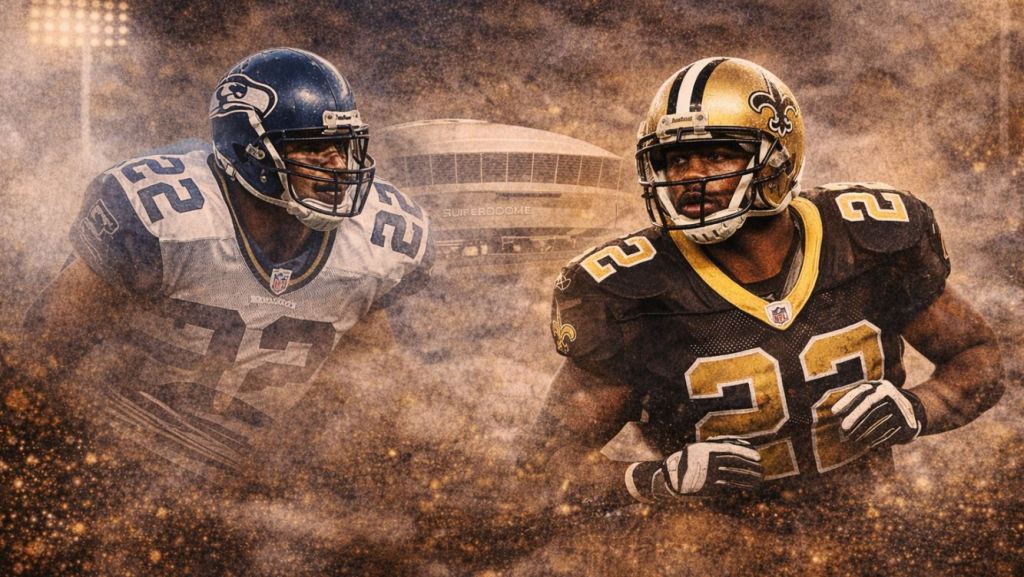
The lights at Trojan Field do not just come on. They wake up.
In the 90’s, Bruce would spend all week moving at its own pace, then Friday night arrives and everything tightens into focus. The parking lot fills the way it always does. The band sounds a little louder than it should. The air carries that particular mix of cut grass and concession stand smoke. People find their places, not because they are assigned, but because that is where they have always stood.
And out there, between the lines, is a kid whose name gets spoken with a little extra certainty.
Fred Thomas was never some polished, made-for-TV origin story. He was something more than that. A player built in routine. Built in repetition. Built in the unglamorous truth that if you want to be taken seriously, you show up and you do the work and you do not ask anyone to notice.
Calhoun County knew him first, before the rest of the football world ever had a reason to. They knew the way he moved. They knew the way he competed. They knew the way defensive backs from tend to play, like every route is personal and every tackle is a statement. They knew, too, that the state produces plenty of talent, but not everyone carries the same edge.
Thomas carried it.
The road out of a place like Bruce rarely goes straight to a marquee. Most of the time it goes through a proving ground, a place where you either sharpen or you disappear. For Thomas, that place was Northwest Mississippi Community College, where junior college football has always functioned like a truth serum. There is no hiding there. You either play, or you do not. You either respond to the grind, or the grind swallows you.
Thomas responded.
He became the kind of athlete coaches love because he simplifies their choices. Put him at corner. Put him on offense if you need a spark. Put him on special teams and watch the field tilt. Junior college teams are full of players trying to make a point. The special ones make multiple points at once.
Thomas did that.
There is a particular kind of courage in returning punts and kicks. It is not the courage that comes from strength or size. It is the courage of standing under a ball while bodies close in from every direction, trusting your hands, trusting your instincts and trusting that you can find daylight in a space that is trying to collapse. Return men live in a world where the punishment is guaranteed and the reward is uncertain.
He flipped field position. He broke games. He turned routine plays into moments people carried home and talked about. It was the first preview of what his professional life would become, not just talent, but willingness. Not just speed, but nerve.
The climb after that was not clean, and clean is overrated.
He spent time at Ole Miss, then finished at Tennessee-Martin, a path that makes sense when you understand what it means to chase a career. Sometimes you move because you have to. Sometimes you move because you are still searching for the right fit. Sometimes you move because the dream does not care about convenience. It only cares about persistence.
And eventually, persistence gets noticed.
The NFL does not offer many invitations. When it does, it comes with a quiet kind of weight. The Seattle Seahawks took Fred Thomas in the second round. A second-round pick is not a sentimental story. A second-round pick is expectation. It is a franchise saying, we believe you are ready, and we are going to find out quickly if we are right.
The first lesson for an NFL cornerback is that the league will locate your weaknesses and revisit them repeatedly until you either fix them or you are replaced. Quarterbacks test you. Coordinators isolate you. Receivers run at you like they have been waiting all week to do it. The game is faster, the windows are smaller and the margin between “on time” and “too late” is microscopic.
Thomas learned the league in real time, and he stayed on the field, which is the most honest measure of a pro. You can talk about potential in August. You can talk about upside in camp. But if coaches keep playing you in October and November, it means they trust you. It means you handle the work.
After four seasons in Seattle, the next chapter took him to a city that understands toughness as a native language.
New Orleans is not gentle with its football. It does not ask politely. It demands. It wants players who can hold up under pressure and it can feel immediately when someone is performing versus when someone is built for it. When Thomas arrived with the Saints in 2000, the fit felt natural. A Mississippi defensive back, disciplined and stubborn, landing in a city that respects both.
That first season in New Orleans did not just add games to his resume. It put him inside a moment that mattered to the franchise. The Saints won their division and then delivered the first playoff win in team history, a breakthrough that still lives in the memory of that fanbase. Teams do not just stumble into milestones like that. They earn them, often through defense, through tackling, through refusing to give an opponent an easy breath.
Thomas became the kind of player who shows up in those moments, not always with a headline, but with presence. With coverage that forces the ball elsewhere. With tackles that end drives. With the kind of steadiness that lets everyone else play a little freer because they know the back end will hold.
His best seasons were the ones that told the fullest story about him. Not just a corner who could run, but a corner who would hit, who would tackle, who would involve himself in the mess of the game rather than orbit around it. Interceptions came too, the kind that change momentum and make a stadium rise all at once. But what separated him was that he was not allergic to contact, and in the NFL, that is a separator. Corners are asked to cover, but the best ones also clean up everything that leaks through.
And then, on one of those chaotic special teams plays where the game breaks structure and becomes instinct, he found the end zone in the most honest way possible. Not on a designed moment that belongs to an offensive star, but on a play that required recognition, urgency and the willingness to run into the chaos, then outrun it. It fit him. It fit the way his whole football life had unfolded.
By the mid-2000s, he was not just a guy on the roster. He was a veteran. A professional in the truest sense. The kind who lasts because he is trusted. The kind who lasts because he takes care of his body, studies the game, understands leverage and angles and route combinations and all the quiet details that separate surviving from thriving.
Then the world changed.
Hurricane Katrina did not just alter New Orleans. It interrupted it. It displaced people. It damaged neighborhoods. It shook the sense of identity that a city holds on to. When the Saints returned to the Superdome in 2006, it was not simply a home game. It was a declaration that something was coming back.
That night, the dome did not feel like a stadium. It felt like a heartbeat.
Monday night against Atlanta, the rivalry that already carried heat, now layered with meaning. The building was full of something bigger than noise. It was grief and pride and defiance, all at once. And on the field were the Saints, including a veteran corner from Mississippi who had built his career on showing up, on doing the work, on not blinking when things got heavy.
The game itself almost became secondary to the feeling of it, the sense of a city gathering itself and remembering what it sounded like to be whole. Football cannot fix what a storm takes. But it can give people a place to stand together for a few hours and feel something that is not loss.
Thomas was part of that. Not a symbol in a speech, but a living piece of the team that carried that night. A pro who had been through the league’s grind and was still there when the moment became historic.
He played until 2008, twelve seasons in the NFL, which is a long time in a sport that treats careers like they are disposable. Longevity like that is rarely about one spectacular trait. It is about habits. It is about resilience. It is about doing the same hard things over and over without needing constant reinforcement.
If you tell Fred Thomas’s story as a list of stops, you miss the point.
Bruce High School is not just where he started. It is the kind of place that teaches you how to carry yourself. Northwest is not just a junior college chapter. It is where his versatility became undeniable. Seattle is not just four seasons on a resume. It is where he learned the league and earned a professional identity. New Orleans is not just where he played the longest. It is where his steadiness met moments that mattered.
And if you want the ending that fits the style of the story, it is not a stat line.
It is an image.
A defensive back, years into a career built on repetition and resolve, walking into the Superdome on the night New Orleans came back, surrounded by noise that sounded like survival.
Not because he was looking for a spotlight.
Because he never needed one.
 GORESPORTS.net
Leave a comment