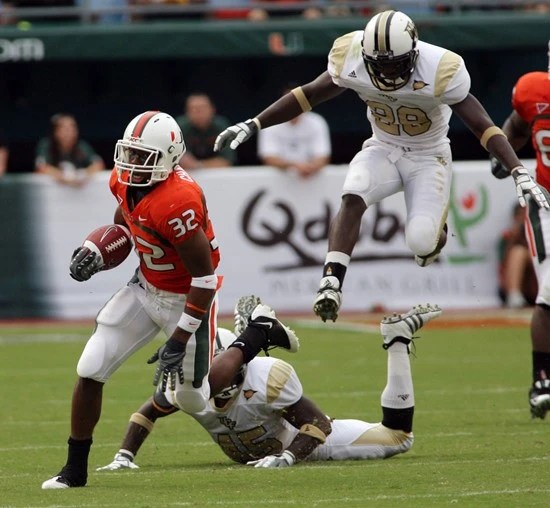
In Coffeeville, Friday nights move at a different speed. The lights hum. The air sits heavy. The grass holds cleat marks like memories. Then Lee Chambers touches the ball and the whole place tilts, like everyone is watching the same thing happen in fast-forward.
It is easy to remember the speed first. Speed is measurable.
But the speed is only the surface of the story. The deeper current is what he chose, again and again, when the game asked him to be something other than the version everyone expected.
A four-star label, Chambers was not just good for Coffeeville. He was good anywhere.
His senior year proved it: 1,325 yards on 158 carries. More than eight yards every time he took the handoff. Fourteen touchdowns. Two nights over 200 yards, the kind of numbers that do not sit quietly in a box score. They announce themselves. They follow you. They become the first line of your introduction.
Those numbers also bring their own kind of pressure. When a town watches you run, it starts to believe that running is who you are. That the future is supposed to look exactly like the past, only bigger, only louder, only under brighter lights.
Miami came calling, that famous haven for speed, swagger and athletes who look like they belong on the same field as anyone. In February 2007, the path tightened from small-town Mississippi to Coral Gables, from a place where everyone knew your name to a place where the name on the front of the jersey is the loudest thing in the room.
At first, the story stayed familiar.
Running back. Offense. Carries, returns and the occasional flash that reminded you who he was when he arrived. Sixty rushing attempts. Two hundred sixty-nine yards. A touchdown. A few kickoff returns. Useful, honest work, even if it was not the headline. Enough to show he belonged, not enough to define him.
Then the story asked for something else.
There is a moment in every player’s life when the question becomes simple and brutal. Do you want what you want, or do you want what the team needs. The secondary was thin. Miami needed help. And Chambers did something that looks simple on paper and feels enormous in real life.
He changed.
A running back is taught to seek space. A defensive back is taught to erase it. One job creates, the other closes. Chambers moved from the player meant to be featured to the player meant to fix things, to cover space, to make fewer mistakes than anyone notices, to do work that rarely earns cheers unless it fails.
By 2011, he was no longer introduced as the offensive weapon from Mississippi. He was a defender, a player trying to make himself useful wherever he could.
The stat line does not shout. Defensive numbers rarely do.
Two tackles in 2010. Fifteen in 2011. Twenty-one across his time in the secondary. A three-tackle night at Maryland to open the season, then steady moments that rarely make montages but often decide whether a drive lives or dies. It was not a reinvention built for applause. It was built to keep the machine running.
There were other parts of him that mattered too, the ones that do not show up in highlight reels.
He finished his degree in four years. He chased a master’s. He faced the push and pull of school and sport, managed a life that is always being graded, sometimes in public. The same discipline that asks you to do your job when nobody is looking is the same discipline that gets you across a graduation stage.
Some careers are remembered for highlights. Others are remembered for the moment a player stops chasing the version of himself he arrived with and starts serving the version his team needs. Chambers did that, and there is a kind of quiet courage in it.
Speed got him noticed, his unselfishness is what makes the story stay.
 GORESPORTS.net
Leave a comment