The history of Mississippi high school basketball is a long road lined with scorers, banners and box scores yellowed by time. But every so often, a name does not just appear in the record book. It settles in.
Robert Woodard Sr. is one of those names.
Not loud.
Not fleeting.
Enduring.
In the early 1980s, in a town small enough that everybody knew who had the ball, Woodard was building something that would last nearly four decades. At Houlka Attendance Center, he did not just score points. He stacked them patiently, relentlessly, until the number 4,274 became less a statistic and more a monument.
Houlka was not a place designed for stardom. It was an attendance center, with elementary school hallways bleeding into high school gyms, younger kids watching older ones, learning the rhythms early. For Woodard, it was repetition before refinement, toughness before polish. The game arrived early and it stayed late.
By the time the 1980s turned, so had heads across the state.
Woodard was 6 foot 4, broad shouldered, built more like a forward but handling the ball like a guard. Houlka’s offense knew exactly who it was, deliberate, disciplined, always circling back to him, and so did every defense he faced. It did not matter. Attention did not slow him. It sharpened him.
He scored because he could endure. Because he understood angles, contact and the quiet arithmetic of effort. No three point line. No spacing designed for freedom. Just hands, bodies and resolve. And still the points came.
As a sophomore, 963.
As a junior, 925.
As a senior, 1,258—thirty five a night, every night, the same question asked and answered again.
When the record finally fell 37 years later, the game itself had changed.
Longer seasons.
A three point arc.
More possessions.
Josh Hubbard broke it. Monta Ellis chased it. Neither diminishes what Woodard built without those advantages. If anything, it clarifies it.
Houlka was small. Exposure was limited. But the truth has a way of traveling. Mississippi State came calling, and in 1986 Woodard became the first signee of Richard Williams, a coach who believed basketball was less about expression and more about responsibility.
College changed him. Or maybe it revealed the other half.
They called him Horse, and he stopped being the scorer he once was. He defended. He absorbed matchups. He did the work that does not echo. Four seasons. Modest numbers. Essential presence. In Williams’ system, trust mattered more than touches, and Woodard earned it.
In 1987–88, he received the Babe McCarthy Memorial Award, a prize not for what shows up in headlines but for what holds teams together, toughness, commitment and reliability.
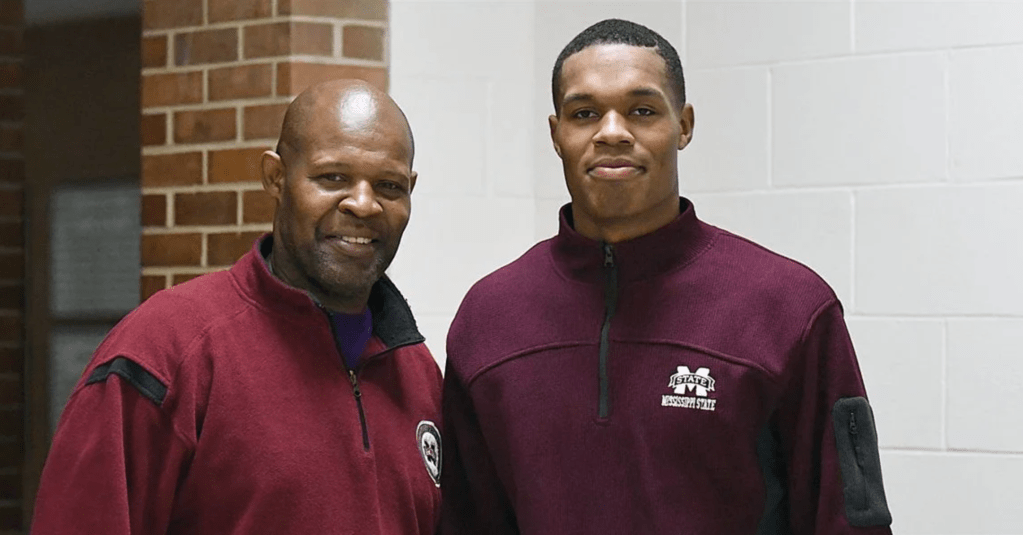
Years later, that same philosophy showed up again, this time in a gym where his son was tying his shoes. Robert Woodard II learned early that scoring fades but readiness does not. Defense travels. Discipline lasts. The son became a champion, a two time Gatorade Player of the Year, an SEC player and an NBA professional. Different game. Same roots.
Robert Woodard Sr.’s legacy lives in two places.
One is obvious, 4,274 points still towering over Mississippi history. The other is quieter, the understanding that greatness adapts. That when the game asks something different, you answer, even if it means giving less and giving more at the same time.
He did not just chase headlines. He built something sturdier.
And that is why the name still remains.
Help support the GoreSports YouTube Channel by subscribing and liking the videos that you watch.
 GORESPORTS.net
Leave a comment