The Notre Dame–Navy football game is more than a date on the calendar. It’s a living pledge. A yearly expression of gratitude. A reminder that loyalty can outlast decades, wars, and conference realignment.
This rivalry, approaching its 100th year, isn’t built on proximity or hatred. It’s built on survival and respect. When Notre Dame needed help during World War II, the United States Navy answered. The Irish have been repaying that debt ever since.
The story started in 1927. Notre Dame beat Navy 19–6 in the first meeting. Knute Rockne’s Irish were national powers. Navy was a proud service program, built on discipline and purpose.
Father Walsh, in that first game’s program, called it a “football triangle” of shared values. He wrote that the outcome mattered less than the spirit of “good-fellowship.” It was prophetic. That spirit would one day keep Notre Dame alive.
When World War II erupted, Notre Dame’s future dimmed. Enrollment collapsed as young men left for service. Without students or funds, the university faced ruin.
The Navy stepped in. In 1943, it established the V-12 College Training Program on campus. The Navy paid for facilities, filled classrooms, and kept the university’s doors open.
Father Theodore Hesburgh later said it plainly. Without the Navy, Notre Dame would have had a few hundred students. The Navy didn’t just provide money. It gave Notre Dame life.
After the war, Notre Dame made a promise. The Irish would play Navy every year. Not as a favor, but as repayment on what has been called “a debt of honor.”
That promise still holds. The annual game is more than a tradition. It’s an act of remembrance. Every kickoff is a nod to 1943, when the Navy kept Notre Dame afloat.
Rev. Theodore Hesburgh protected the rivalry for decades. He insisted that no scheduling pressure, no television deal, no conference tie could break the bond. When Notre Dame began its partial ACC agreement, the Navy game stayed. Always.
His reasoning was simple. “If they had won,” he once said, “we would not have felt terribly bad, because they’re the best friends we’ve got.”
Another figure stands at the heart of this story: Edgar “Rip” Miller. He played for Notre Dame, then spent his life at the Naval Academy as a coach and administrator. The Rip Miller Trophy, created in 2011, honors his dual legacy. It’s awarded to the winner each year, but it represents something greater than victory. It represents shared history.
The rivalry has seen 97 meetings through 2024. Notre Dame leads 81–13–1. For 93 straight years, from 1927 to 2019, the two teams met annually, making it the longest uninterrupted intersectional rivalry in college football history.
Notre Dame once won 43 in a row, from 1964 to 2006. It was the longest streak in NCAA history. Yet the games continued. Even when the outcomes were predictable. Because ending the series was never an option.
In 2007, Navy broke through, winning 46–44 in triple overtime. It was a stunning, emotional upset that snapped four decades of frustration. Navy won again in 2009, 2010, and 2016. Notre Dame has held serve since. But each game still feels bigger than the score.
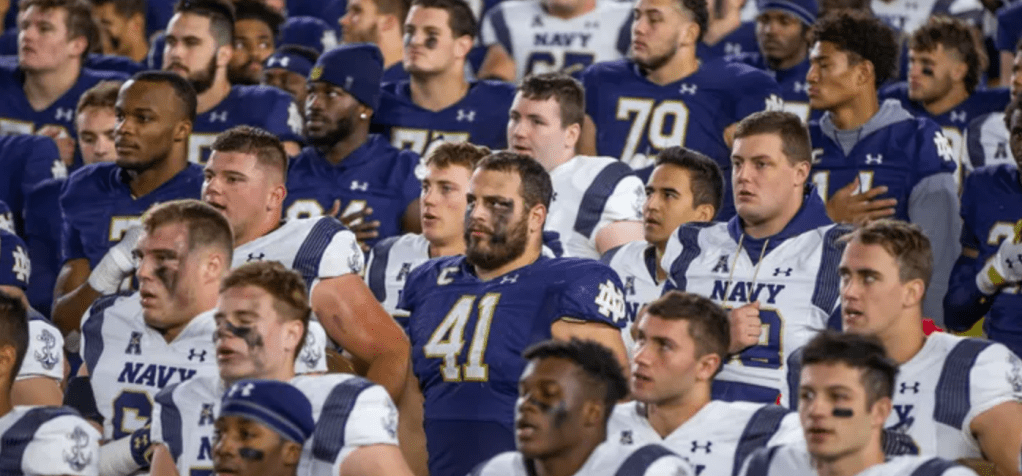
Since 2005, the post-game tradition has defined this rivalry. Both teams stand for each other’s alma mater. Players shoulder to shoulder, heads high, no matter who won.
It’s a powerful image. The Irish honoring the service academy that once saved them. The Midshipmen honoring the university that never forgot.
The Rip Miller Trophy adds a tangible layer to that respect. And when the Blue Angels roar overhead before kickoff, the symbolism is complete. This is college football elevated—history in motion, gratitude in flight.
This rivalry doesn’t stay put.
Baltimore has hosted the most games, with 22 meetings. Philadelphia, Cleveland, East Rutherford, and San Diego have all staged it too. Each site reflects a strategic choice of places with naval heritage, strong alumni bases, and the chance for Navy to benefit financially.
And then there’s Ireland. The teams have played in Dublin three times, most recently in 2023. It’s a global stage for an American promise.
Through wartime alliances, record streaks, and international showcases, one truth stands firm. The Notre Dame–Navy rivalry isn’t about competition. It’s about commitment.
Notre Dame still honors its debt of honor from 1943. The series is locked in through 2032. And every year, when the Irish and Midshipmen meet, they don’t just play a football game. They renew a vow made in the middle of a world at war.
Some rivalries are about pride. This one is about gratitude. And gratitude, like the game itself, endures.
 GORESPORTS.net
Leave a comment