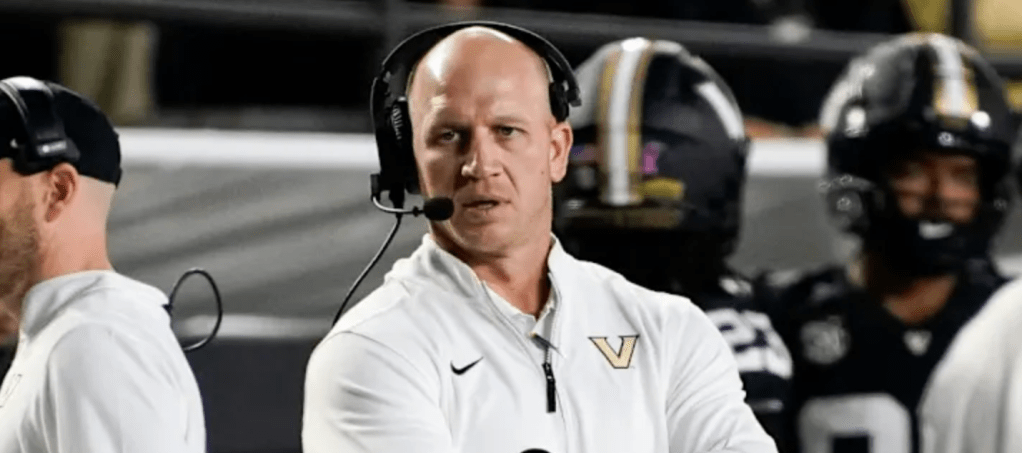
Clark Lea’s name now belongs in the national coaching conversation.
That fact alone signals how dramatically the ground has shifted beneath college football’s 2025 hiring cycle.
In a year defined by volatility, with nine Power 4 jobs opening before November and nearly $100 million in buyouts already committed, programs are looking for stability they can trust. Lea represents that shift. He has turned one of the sport’s hardest jobs into a credible success story.
Vanderbilt is 6–1, ranked No. 17 in the nation, and operating with a level of consistency the program has not seen in decades. The team finished 7–6 in 2024, won its first bowl game since 2013, and produced the SEC Coach of the Year. Those facts carry weight in a market obsessed with trajectory and proof of concept.
Lea’s overall record, 21–34, does not tell the story. His program has improved faster than any in the conference. Vanderbilt’s Simple Rating System jumped from –9.20 in 2023 to +16.71 midway through 2025. His defense is allowing 23.4 points per game, the program’s best mark in ten years. The win over No. 1 Alabama was not symbolic; it was validation that Lea’s system can beat elite opponents in real conditions.
This combination of progress and precision has elevated Lea’s market value. His buyout, estimated between $13 and $15 million, is seen as modest in a cycle where Penn State paid more than $50 million to remove James Franklin. Virginia Tech’s lower termination cost for Brent Pry, roughly $6 million, leaves the Hokies with enough budget to pursue a candidate of Lea’s caliber without exceeding market norms.
Both programs are connected to Lea in early conversations. Penn State’s search focuses on leadership stability after a decade of inconsistency. Virginia Tech is prioritizing defensive structure and a program reset. Lea fits both needs. His background as Notre Dame’s defensive coordinator and his success as a cultural architect at Vanderbilt make him an efficient, low-risk option for institutions unwilling to repeat the financial and reputational turbulence of the past few seasons.
Lea’s appeal also extends beyond performance metrics. He manages personnel effectively, often succeeding with unconventional roster construction. Quarterback Diego Pavia, a transfer who now leads the SEC in touchdown passes, reflects Lea’s ability to identify and develop impact players through nontraditional recruiting paths. That adaptability resonates in a landscape shaped by the transfer portal and NIL-driven turnover.
Vanderbilt’s leadership understood Lea’s potential value when it extended his contract through 2029 in 2023. The extension created stability for the program but also established a market price. His current salary, approximately $3.75 million, ranks near the bottom of the SEC. A move to a Power 4 contender would likely elevate that figure above $6 million annually. For Vanderbilt, any departure would trigger a significant buyout payment that could fund ongoing facility projects, effectively monetizing his success.
Lea has become a case study in institutional patience. Vanderbilt stayed the course through difficult early seasons and is now benefiting from the payoff. The larger market is watching that trajectory closely. In an era of reactionary firings and costly resets, Lea’s progress represents a rare form of sustainability.
His name will continue to circulate in the upper tier of coaching discussions because he offers what few others do: a proven model for cultural and competitive transformation within structural limits. That skill has become the most valuable currency in modern college football.
 GORESPORTS.net
Leave a comment