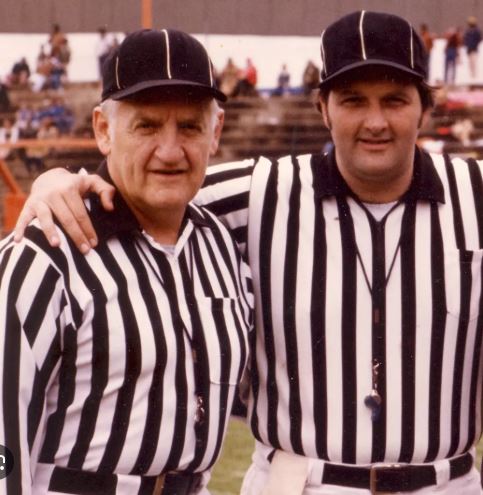
A.C. “Butch” Lambert grew up in Holcut, Mississippi. Born in 1923, he would become one of the most respected officials in the Southeastern Conference. His story stretches from a small Mississippi town to the biggest stages in college football. It is a story of service, resilience, and a lasting legacy in both athletics and education.
He started at Itawamba AHS, graduating in 1941. That same year, the school’s leadership began the process that would eventually create Itawamba Junior College. Lambert was on campus at the moment the seeds of a college were planted. Decades later, he would return to shape its athletic identity.
Like so many of his generation, Lambert’s life was interrupted by war. He served in the United States Navy from 1943 to 1946. While in uniform, he continued playing football, lining up at center for the Great Lakes National Service Championship team coached by Paul Brown. That experience kept him connected to the game and placed him under the guidance of one of football’s greatest minds.
After the war, Lambert attended Ole Miss. He joined Johnny Vaught’s football team, but an injury ended his playing career. Instead of cutting him loose, Vaught kept him on as a manager and trainer. That shift from player to support staff gave Lambert a new perspective. It was the moment that redirected his path toward officiating and administration.
In 1948 he landed his first coaching job at Southwest Junior College. A year later, he returned home to Itawamba Junior College. He was hired as the school’s first head football coach and athletic director. More than a coach, he was a builder. He started the program from scratch, establishing the foundation for what ICC athletics would become.
His public life stretched beyond sports. Lambert also served as a legislator in Mississippi. He was a civic leader as well as a figure in athletics, shaping his community from multiple fronts.
Officiating became the central chapter of his career. From 1953 to 1982, Lambert was a football line judge in the SEC. From 1953 to 1973, he also worked as a basketball referee. Few could match that kind of dual-sport longevity. He rose to become President of the SEC Football Officials Association and later Chief Line Judge. He was trusted not only to make calls on the field but also to help set the standard for his profession.
Twelve bowl games. Two national championship Orange Bowls. In 1975 he worked Notre Dame versus Alabama. In 1982 it was Clemson versus Nebraska. He also officiated four NCAA regional basketball tournaments. When the stakes were highest, Lambert was there.
His career unfolded as the SEC itself was growing into a national power. The conference needed reliable officials who could manage faster games and higher stakes. Lambert delivered consistency across three decades. His position as line judge demanded adaptability as offensive styles evolved. He met the challenge every time.
Even after his passing in 1985, his presence endures.
In 1994, Itawamba Community College named its football stadium A.C. Lambert Stadium. It was a permanent reminder that he was not just a coach or an administrator but a founder of the school’s athletic tradition. The same year of his death, his family and friends created the A.C. “Butch” Lambert Sr. Memorial Scholarship at Ole Miss. Between the scholarship and the stadium, the two most important institutions in his life honored him in ways that captured his journey.
The final recognition came in 2000 with his induction into the Mississippi Sports Hall of Fame. That honor is rare for an official. It placed him in the company of the state’s greatest athletes and coaches, a fitting tribute for a man who gave his life to the game.
Lambert’s legacy is one of integrity and influence. He served his country. He built a program at ICC. He shaped policy as a legislator. He became one of the most trusted officials in the Southeastern Conference. And his name lives on in stadiums, scholarships, and a Hall of Fame.
In Mississippi’s Hill Country, legends are not only made on the field. Sometimes, they are made by the people who ensure the game is played with fairness, consistency, and honor. Lambert was one of those people.
 GORESPORTS.net
Leave a comment