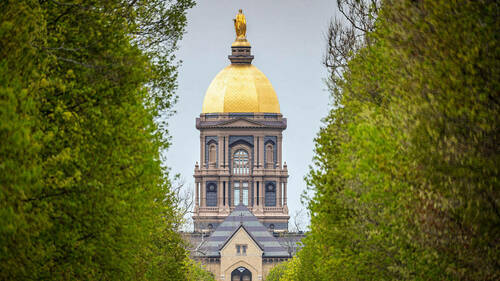
The University of Notre Dame’s athletic legacy has been built on a national recruiting philosophy, drawing talent from traditional powerhouses like California, Florida, Ohio, and New Jersey. Yet, woven into this rich tapestry is a far more delicate and sparsely populated thread connecting the campus in South Bend to the state of Mississippi. Historically, Mississippi has been one of the least represented states on Fighting Irish rosters, a statistical reality that makes the connection seem tenuous at best. In its 127-year history leading into the mid-2010s, Notre Dame had pulled a mere six football players from the Magnolia State.
However, history reveals a narrative that transcends mere numbers. The story of Notre Dame’s Mississippi athletes is one of disproportionate impact and profound significance. This small, select cohort includes a College Football Hall of Famer who was the cornerstone of a national championship dynasty, a record-shattering quarterback who etched his name in the school’s record books, and a scholar-athlete who perfectly embodied the university’s highest ideals by excelling as a dominant lineman while simultaneously attending law school. Their collective careers demonstrate a powerful theme of quality over quantity, suggesting that when Notre Dame has successfully recruited from Mississippi, it has often found individuals of exceptional talent, character, and historical importance.
The Gridiron Connection – A Legacy Forged in Football
The athletic bond between Mississippi and Notre Dame has been forged almost exclusively on the football field. From the golden age of Knute Rockne to the modern era, a small but impactful group of players has made the journey from the Magnolia State to South Bend, leaving an indelible mark on the storied program.
The Founding Father: Marchmont “Marchy” Schwartz (1929-1931)
The story of Mississippi athletes at Notre Dame begins at the zenith of the program’s history with Marchmont “Marchy” Schwartz, the first and arguably most decorated player to hail from the state. A native of Bay St. Louis, Schwartz was a unique figure for his time; of Jewish heritage and educated at St. Stanislaus College for high school, he transferred to Notre Dame from Loyola of New Orleans after his freshman year and immediately became a pivotal weapon for legendary coach Knute Rockne.
Schwartz’s arrival coincided with the final, dominant chapter of the Rockne era. He was a key offensive force on the undefeated, consensus national championship teams of 1929 (9-0-0) and 1930 (10-0-0). As a junior in 1930, he produced one of the greatest individual seasons in early Irish history, rushing for 927 yards and nine touchdowns on 124 carries, an astounding average of 7.5 yards per attempt. That yardage total set a school record that stood for 46 years. He also proved to be a capable passer, throwing for 319 yards and three touchdowns that season.
Over his three-year varsity career, Schwartz amassed 1,945 rushing yards and 17 touchdowns, averaging a remarkable 5.8 yards per carry. His performance earned him widespread recognition, and his legacy is cemented in Notre Dame and college football lore.
Honors and Championships:
- National Champion: 1929, 1930
- Consensus First-Team All-American: 1930, 1931
- College Football Hall of Fame: Inducted in 1974
- Notre Dame All-Time Eleven: In 1962, a panel of sportswriters named him to the program’s all-time team, placing him in a backfield with legends George Gipp, Jim Crowley, and Johnny Lujack.
Schwartz’s career established a precedent, demonstrating that elite talent from the Deep South could not only succeed but achieve legendary status at Notre Dame. He remains the gold standard for any athlete following the path from Mississippi to South Bend.
A Brief Interlude: Eddie Hornback (1979)
After Schwartz’s departure, nearly five decades passed before another Mississippian appeared on the Notre Dame football roster. That player was Eddie Hornback, a highly touted quarterback from Ocean Springs. In 1978, Hornback was one of the most sought-after recruits in the nation, deemed a top 100 prospect who drew interest from nearly every major football power.
His commitment represented a significant recruiting victory for Notre Dame in the heart of SEC country. However, his career in South Bend was brief. He played sparingly as a freshman in 1979 before suffering a knee injury during the team’s trip to Japan for the Mirage Bowl. Following the injury, he switched positions to safety before ultimately deciding to transfer to Mississippi State. He went on to letter for the Bulldogs in 1982 and 1983.
The 1990s Wave: A Southern Recruiting Surge
The 1990s marked the most concentrated period of Mississippi representation in Notre Dame’s history, a clear result of a strategic recruiting expansion under head coach Lou Holtz. In a span of just five years, the Irish signed four players from the Magnolia State, each of whom would contribute to the program’s success in his own unique way.
Will Lyell (1992-1995)
Will Lyell arrived in South Bend from Brandon with a sterling reputation. A decorated offensive lineman, he was named a USA Today First-Team All-American and the Gatorade Player of the Year for Mississippi. He quickly made an impact, earning a spot in the starting lineup early in his sophomore season in 1993 on a team that would finish 11-1 and ranked No. 2 in the country. Unfortunately, his promising career was ultimately derailed by persistent injuries, most notably a debilitating back issue that forced him to stop playing. Despite the premature end to his playing days, Lyell was a letterwinner and a scholar-athlete, graduating with a degree in Finance.
Mike Frascogna (1992-1995)
Arriving in the same class as Lyell was Mike Frascogna, a walk-on wide receiver from Jackson. Coach Lou Holtz described Frascogna as a “statistical oddity”. He was undersized, had transferred to Notre Dame as a student after playing one season of Division III football at Millsaps College, and was one of the rare walk-ons to join the team just before the start of the season rather than through spring tryouts.
Despite the long odds, Frascogna’s perseverance was remarkable. He remained with the team for four seasons (1992-1995), a rare feat for a walk-on, and saw game action in each of his last three years. During his time at Notre Dame, the Irish posted a formidable 36-10-2 record and played in four New Year’s Day bowl games. In 1995, he earned a varsity monogram for his contributions on special teams and was selected by his peers to speak at the prestigious Notre Dame Quarterback Club luncheon before the final home game.
Jarious Jackson (1995-1999)
Next to Schwartz, quarterback Jarious Jackson is the most prominent football player from Mississippi to ever don the blue and gold. A native of Tupelo, Jackson was a highly sought-after prospect who committed to Notre Dame under Lou Holtz. He played sparingly during his first two seasons behind established starter Ron Powlus.
In 1998, under new coach Bob Davie, Jackson seized the starting role and orchestrated a breakout season. His debut came in a 36-20 victory over a Michigan team that featured a first-time starter at quarterback named Tom Brady. A dynamic dual-threat, Jackson led the Irish to a 9-1 start, throwing for 1,740 yards and 13 touchdowns while rushing for 441 yards and 3 more scores. His brilliant season was cut short when he suffered a knee sprain while taking an intentional safety to seal a dramatic 39-36 victory over LSU, forcing him to miss the season-ending loss to USC.
As a senior in 1999, Jackson was bestowed the rare honor of being named the sole team captain. He responded with one of the most productive offensive seasons in school history. He set new single-season Notre Dame records for passing yards (2,753), completions (184), and attempts (316), breaking Joe Theismann’s 29-year-old passing yardage mark. Combined with his 464 rushing yards and 7 rushing touchdowns, his 3,217 yards of total offense also broke a school record held by Theismann. Though he received no formal All-American honors, his record-setting performance and captaincy stand as testaments to his excellence. Jackson was drafted in the 7th round by the Denver Broncos and went on to a long and successful 13-year professional career, primarily in the Canadian Football League (CFL), where he won three Grey Cup championships.
Jay Johnson (1996-2000)
Following Jackson to South Bend was Jay Johnson, a wide receiver from Starkville. Playing under Coach Holtz, Johnson carved out a solid career as a reliable receiver. Over 36 career games, he caught 15 passes for 312 yards and three touchdowns. His most memorable moment came in 1999, when he and Jackson connected for the game-winning touchdown pass with 36 seconds left in a 28-24 victory over Navy. Johnson graduated in 2001 with a degree in sociology and computer applications.
4. The Modern Era and Beyond
After the surge of the 1990s, the recruiting pipeline from Mississippi to Notre Dame returned to a more sporadic pattern. However, the players who have made the journey in the 21st century continued the legacy of high-achieving individuals who represent the university’s core values.
Chris Stewart (2006-2010)
Chris Stewart stands as perhaps the ultimate embodiment of the Notre Dame student-athlete ideal. Raised in Greenwood, Stewart was a formidable physical presence on the field at 6-feet-5 and 351 pounds. After settling in at offensive guard, he became a fixture on the Irish offensive line, starting the final 22 games of his career in the 2008 and 2009 seasons. In 2009, he was a key component of a powerful offense that averaged over 450 total yards per game.
Stewart’s on-field success was matched, if not surpassed, by his academic prowess. In an almost unprecedented achievement, he was the only active Division I football player in the nation who was also enrolled in law school. He completed his undergraduate degree in history in just three and a half years, graduating with a 3.536 cumulative GPA. His remarkable dual achievement was recognized nationally when he was named a National Football Foundation (NFF) National Scholar-Athlete, an honor that came with an $18,000 postgraduate scholarship.
Caleb Offord (2020-2021)
A decade after Stewart, Notre Dame returned to Mississippi to sign Caleb Offord, a three-star cornerback from Southaven. He was the first player from the state to sign with the Irish during Brian Kelly’s tenure as head coach and enrolled early in the spring of 2020. Offord’s time in South Bend was limited; he appeared in four games across two seasons (2020 and 2021), seeing action against South Florida, Florida State, Toledo, and Navy. He subsequently transferred to the University at Buffalo and later to Alabama State to continue his collegiate career.
While the road from the Magnolia State to the Golden Dome is one less traveled, it has been a path of profound importance. The select few who have made the journey have left an indelible and distinguished mark, weaving a unique and valuable thread into the fabric of one of America’s most storied athletic programs.
 GORESPORTS.net
Leave a comment