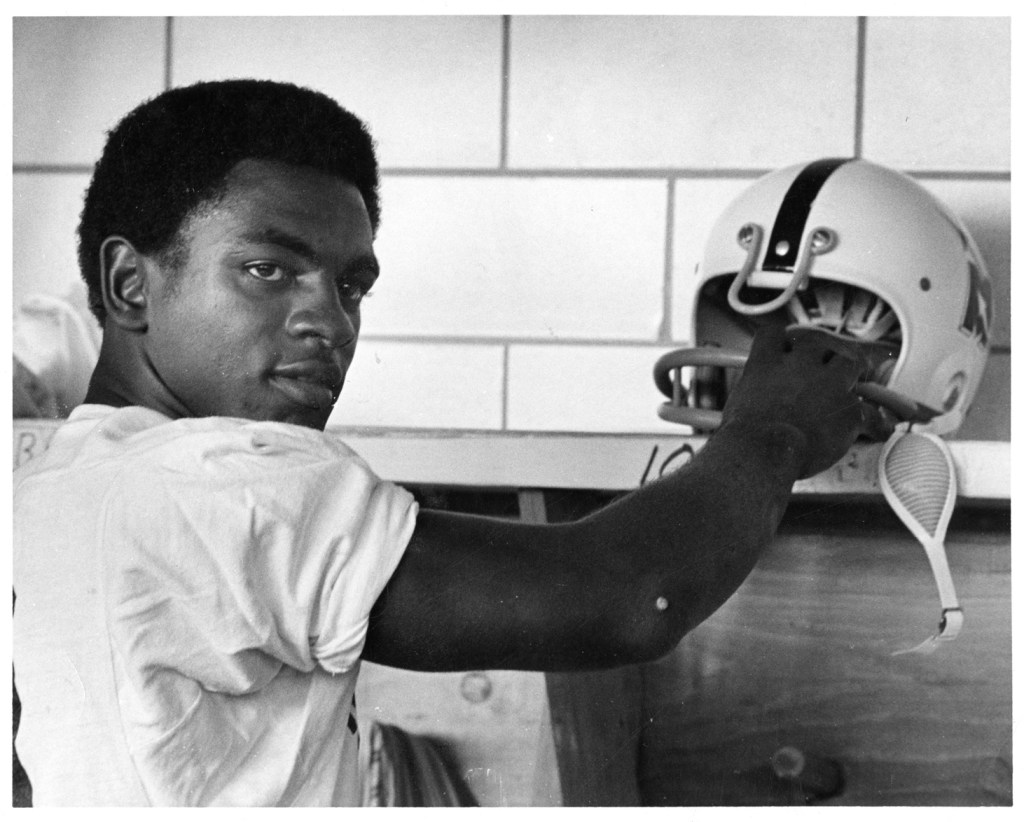
Frank Dowsing was born in Tupelo in 1951, stepping into a world divided by segregation. For a young Black athlete in Mississippi, the opportunities were few. But Dowsing wasn’t just another kid with talent. He had a sharp mind, relentless drive, and the kind of character that could win people over without a word. He didn’t just live in his time… he changed it.
They call him the Jackie Robinson of Mississippi. Not because he stood on a podium and shouted, but because his performance made arguments pointless. On the field and in the classroom, he proved stereotypes wrong and forced people to see him for what he was: a champion in every sense.
He grew up in the Palmetto community outside Tupelo, raised in a close family and shaped by hard work in the cotton fields. In the 1950s and 60s, Tupelo had a rare setup. Robins Field hosted the white Tupelo High Golden Wave on Friday nights, and the all-Black George Washington Carver High Blue Devils on Saturdays. Both games drew crowds of every color. Fans came for the football and the award-winning band, creating one of the few shared public spaces in town.
By the mid-60s, the “Freedom of Choice” plan allowed Black students to enroll in white schools. In 1967, Dowsing left Carver to attend Tupelo High, one of only five Black students to make the jump. A car accident just before school started left him with a broken jaw, wired shut. He entered an uncertain and possibly hostile environment unable to speak. People judged him by his actions, not his words.
It didn’t take long for him to make an impression. His first play in a B-team football game went for a touchdown. From 1968 to 1970, he became a three-sport star. In football, he was the first African-American selected to the All-Big Eight Conference. In basketball, he broke another barrier as the first Black player in the Mississippi State Tournament, helping Tupelo win the Grand Slam title. In track, his speed was unmatched, winning state championships in the 100 and 220 and setting a state record in the 100-yard dash at 9.5 seconds. He was named MVP in both basketball and track.
Not every town welcomed him. Away games brought open hostility. But Dowsing never responded. He just played harder, earning the loyalty of his teammates and the respect of coaches. Off the field, he was just as committed, graduating sixth in a class of 219.
In 1969, Dowsing and Robert Bell became the first Black football players at Mississippi State. The Bulldogs hadn’t had a winning season in seven years, but that changed quickly. Dowsing was a three-year starter at defensive back, recording 10 career interceptions, a school record at the time, and still holds the program’s record for punt return average. His most famous play came in the 1970 Egg Bowl, when he intercepted a pass in the end zone to seal a 19-14 upset of No. 10 Ole Miss.
He wasn’t just a star athlete. He was a scholar, a pre-med major with a 3.2 GPA, Dean’s List honors every semester, and three Academic All-SEC selections. In 1972, he became the first Black student ever elected “Mr. Mississippi State.”
Drafted by the Philadelphia Eagles in 1973, Dowsing instead chose medical school.
Today, his legacy stands tall. Mississippi State honors him with the Dowsing-Bell Plaza at Davis Wade Stadium, the Dowsing-Bell Award for character, and tributes like the 2022 throwback uniforms marking the 50th anniversary of his final season. He’s a member of both the Mississippi Sports Hall of Fame and the MSU Sports Hall of Fame.
Frank Dowsing’s life was filled with firsts, records, and honors. But the real story is how he carried himself through them. He didn’t just open doors… he held them open for others. That’s why he will forever be a true Hill Country Legend.
 GORESPORTS.net
Leave a comment